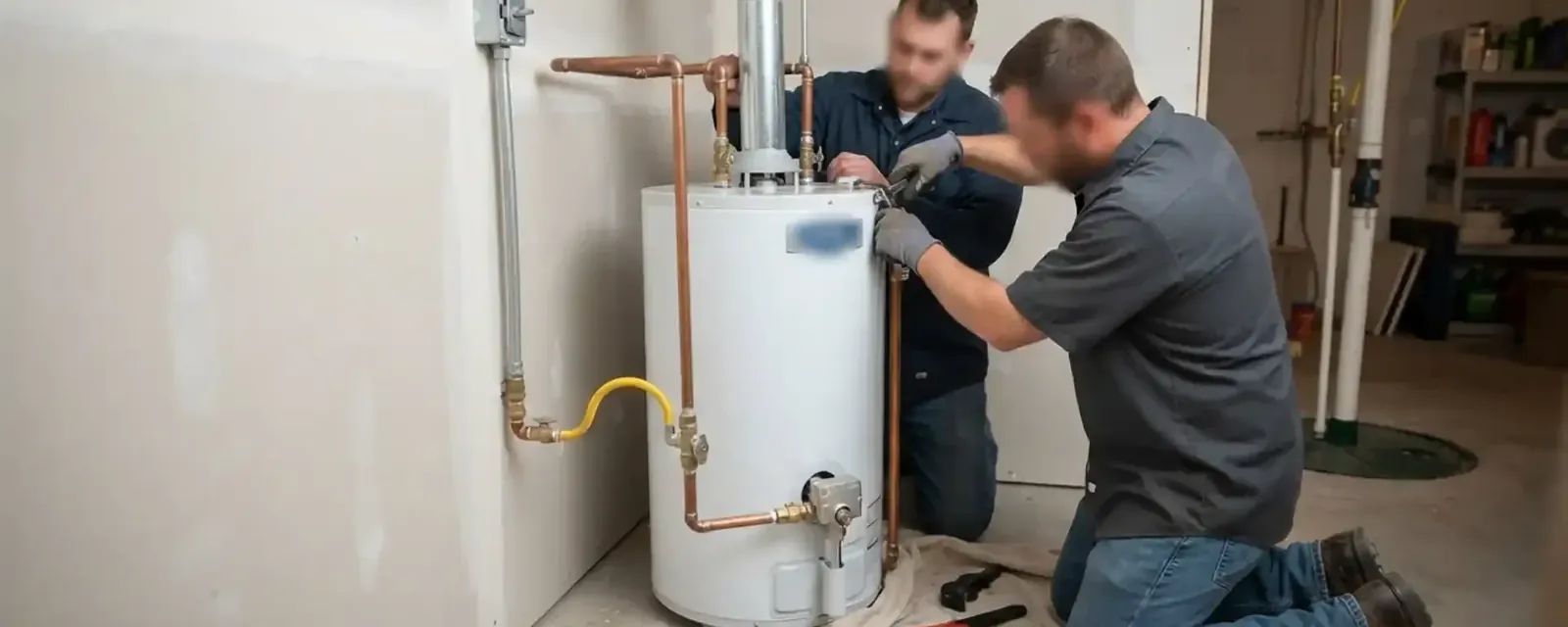
Water heater installation is the planned placement and hookup of a new unit, including the supply lines, fuel or power, venting, relief valve piping and a drain pan where needed. Call (630) 822-9290 to schedule one. Our line is open 24/7, so you can also reach us outside normal business hours.
Before the visit, clear a three-foot path to the old heater or the planned spot, and take a photo of the rating plate if you can. That plate tells the plumber the size, fuel and model, which saves time at the door.
Who needs a planned installation
Most installs follow a failure, but plenty are planned. A remodel may move the heater. A new addition may need a second unit. A homeowner may want to switch fuel before the old tank gives out.
Planning gives you time to compare types, choose the location and have the right permit handled before the old tank leaks. If the old heater has already failed, our water heater replacement page is the faster path.
Safety steps on every install
These checks protect your household, and you can ask the plumber to walk you through each one.
- Gas smell means leaveIf you smell gas at any point, leave the house and call 911 or your gas utility from outside. Do not touch switches or try to relight anything.
- Vent and combustion airGas units need a sound vent path and enough air to burn cleanly. A blocked or leaking vent can put carbon monoxide in the house.
- Relief valve dischargeThe temperature and pressure relief valve needs a discharge pipe routed down to a safe spot, with no cap or plug on it.
- Power and fuel off firstBefore any connection is opened, the breaker is off or the gas is shut at the unit. Power returns only after the tank is full.
Installation, in the order it happens
The order matters because each connection depends on the one before it.
- 1
Walk-through
The plumber checks the location, floor, venting path, drain and fuel or electric supply.
- 2
Shutoff and drain
Water is shut off, the old unit is drained and disconnected.
- 3
Set and level
The new unit goes on a proper pan or platform and is leveled.
- 4
Connect
Water lines, gas or electric, flue or vent, and relief valve discharge are connected.
- 5
Fill and purge
The tank is filled, air is purged from the lines and all joints are checked for leaks.
- 6
Start and test
Burner or elements start, temperature is set, and safety devices are tested.
How to prepare for the install visit
A little prep shortens the visit and keeps your belongings safe.
Venting and combustion air on gas units
Gas heaters make exhaust that has to leave the house. An atmospheric unit uses a draft hood and a vertical flue that relies on rising warm air. A power-vent unit pushes exhaust out through plastic pipe with a fan.
Each design has its own routing rules, and a flue that worked for the old tank may not suit the new one. This is why the installer checks the vent pipe, the clearances and the air supply to the room. Never skip it, because carbon monoxide has no smell.
Connections checked on every install
This is the short list a plumber works through before calling the job done.
| Connection | What we check | Why it matters |
|---|---|---|
| Water supply | Shutoff valve, flexible connectors, heat traps | Leaks and thermal backflow |
| Relief valve | Correct rating, discharge pipe routed down to a safe spot | Pressure and temperature protection |
| Expansion control | Expansion tank present and charged where required | Protects fixtures from pressure spikes |
| Fuel or power | Gas connection tested, or breaker and wire size matched | Safe operation |
| Venting | Material, slope, clearances and termination | Safe exhaust and proper draft |
| Drain pan | Pan with a drain path where a leak would do damage | Limits water damage |
Requirements vary by unit and home. The plumber confirms the details on site.
Planning an install?
Call dispatch, describe the heater and where it sits, and we will book a visit that fits your schedule.
Illinois and Darien rules
Illinois requires a license for anyone who installs plumbing, and the work is measured against the standards in the Illinois Plumbing Code (Title 77, Part 890 of the Illinois Administrative Code) plus the manufacturer's installation guidelines for your unit. The state offers a public license verification tool, and you should use it for any plumber you hire.
In Darien, permits are required whenever plumbing is changed, and contractors register their state license with the City. Water heater permits are not listed on the City's page, so ask the Community Development Department at 1702 Plainfield Rd before the install is scheduled.
What moves the price of a new installation
Every home is different, so there is no flat menu. You hear a clear price before work starts.
Want a real number? Call (630) 822-9290 and describe the project.
Pairing the install with other work
A new heater is a good moment to fix worn shutoffs, add a recirculation loop or deal with a leaking line nearby. If you suspect a hidden leak, our leak detection service can trace it before the new unit goes in.
Water heater installation questions
Yes. Dispatch is open 24/7 at (630) 822-9290, and we offer same-day appointments when available. Tell dispatch your preferred time and we will confirm what we can do.
A straightforward swap is often a half day or less, though a relocation, a new vent run or a fuel change can stretch it. The tank also needs time to heat after filling.
Often yes when the home has a closed water system, such as with a backflow preventer or pressure-reducing valve. The plumber checks and tells you.
Darien requires permits whenever plumbing is changed, but the City's page does not list water heaters. Ask the Community Development Department before scheduling.
Yes, subject to gas line size, venting and the home layout. We cover that in detail on our tankless page.
Yes. The same team serves Woodridge, Downers Grove, Willowbrook and Westmont.